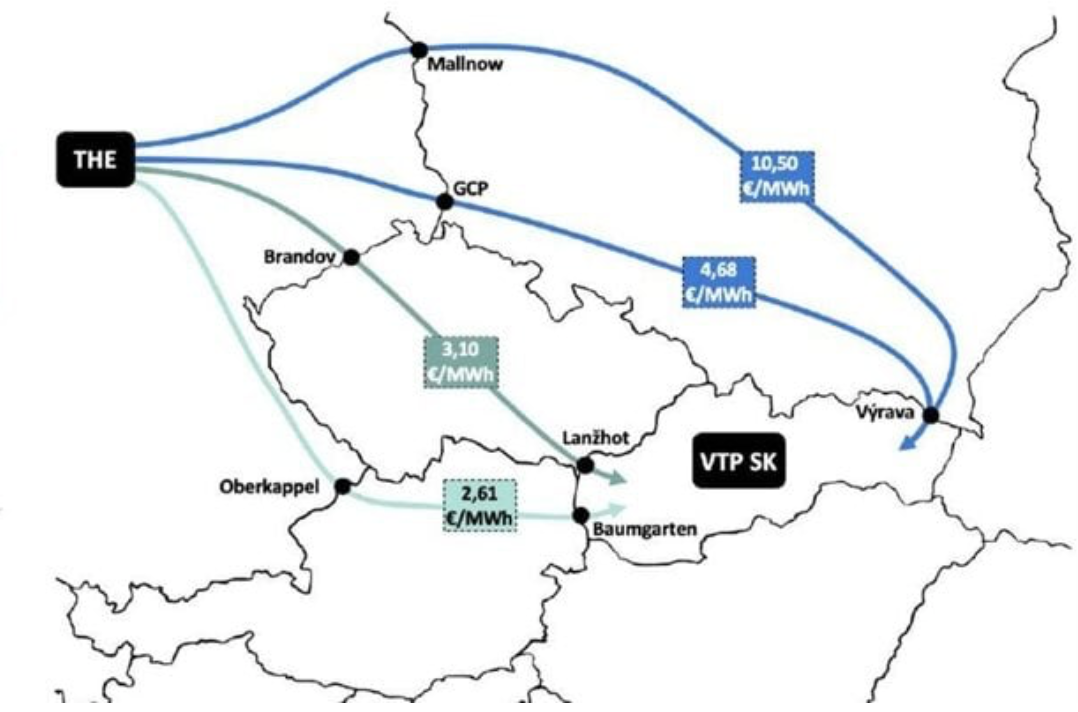
The annual expenses of the leading energy company of Slovakia SPP a.s., which is fully owned by the state and provides natural gas to 70% of the population, for the purchase of energy resources from alternative sources and its physical transportation to the territory of Slovakia without using the Ukrainian route can increase by no more than 90 million euros. During 2025, the optimal means of gas transportation, according to SPP representatives, may be a pipeline from Germany through Austria and the Czech Republic, which has sufficient free capacity and a relatively low tariff.
The gas transportation route to Slovakia via Poland is characterized by the most expensive tariff at 4.68 and 10.50 euros per MWh and is used by Slovak companies to a limited extent. The route via Germany and the Czech Republic costs 3.10 euros per MWh, and via Germany and Austria – 2.61 euros per MWh. The amount of transit fees is determined by the regulator separately in each EU member state. The calculation takes into account the length and load of the route, the volume of transported raw materials, the transportation schedule, as well as the duration of the contract and the price of gas stored in storage tanks. Most of the GTS costs are incurred to maintain the functionality of the pipelines, regardless of whether large or small volumes of raw materials flow through them. This means that the more GTS capacities are used, the lower the transportation fees can be, since the costs are distributed over a larger volume of gas.
The operator of the Slovak GTS, Eustream, has the infrastructure capabilities to enter the Norwegian natural gas market (PL-SK interconnector + Baltic Pipe gas pipeline) and the global LNG market, in particular through the Polish LNG terminals Świnoujście (with a capacity of up to 8.3 billion cubic meters of gas/year), Gdansk (up to 6.1 billion cubic meters of gas/year in 2025), the Lithuanian LNG terminal Klaipeda (up to 3.75 billion cubic meters of gas/year), the Croatian LNG terminal Krk Island (with a capacity of 5.3 billion cubic meters of gas/year in 2027), and Romanian fields in the Black Sea.
As part of the further development of the Poland-Slovakia (PL-SK) gas interconnector project, which has been in operation since 2023, Eustream plans to increase the technical capacity of gas transportation to 12.8 billion cubic meters of gas per year towards Poland and to 10.1 billion cubic meters of gas per year towards Slovakia by 2027. The current “Eustream Transmission Network Development Plan for 2023-2032” includes a project to increase the throughput capacity of the interstate gas pipeline connection point on the Slovak-Hungarian border (Veľké Zlievce) to 5.35 billion cubic meters of gas per year by 2025. The close proximity of the Austrian gas hub in Baumgarten – Central European Gas Hub AG (CEGH) to the Slovak border allows for gas supplies from the gas markets of Western Europe.
Currently, the total capacity of the interstate gas pipeline connection points on the Slovak border, which allow for the physical flow of gas in both directions, in particular with Austria (Baumgarten), the Czech Republic (Lanžhot), Ukraine (Veľké Kapušany, Budince), Hungary (Veľké Zlievce) and Poland (Výrava), is up to 150 billion cubic meters of gas/year, with the country’s annual need for natural gas of up to 4.3 billion cubic meters.
Slovakia’s access to international gas markets in 2025 is secured by a number of contracts concluded by the SPP company with international traders BP, ExxonMobil, Shell, ENI, RWE.
Thus, Slovakia has a gas pipeline connection with each neighboring country and sufficient opportunities for diversification of transportation routes. An alternative transport route could be a gas pipeline from Germany through Austria or the Czech Republic, provided that there is sufficient free or already reserved transport capacity. The southern transport route through the Turkish Stream gas pipeline, Turkey, Bulgaria, Serbia and Hungary currently allows covering most of the domestic consumption.
Gas delivery through Poland for Slovak energy companies is complicated not only by the high tariff, but also by the need for licensing by the Polish GTS operator, Gaz-System. Despite this, during 2024, a number of regional energy supply companies, in particular those of the Western and Eastern regions of Slovakia (Západoslovenská energetika, a.s., ZSE, 21% of the electricity supply market, Východoslovenská energetika, a.s., VSE, 10% of the market), 51% of whose shares are owned by the Slovak government, entered the Polish market and provided up to 30% of the annual consumption needs with American liquefied gas from the Lithuanian port of Klaipeda.
